

Blog
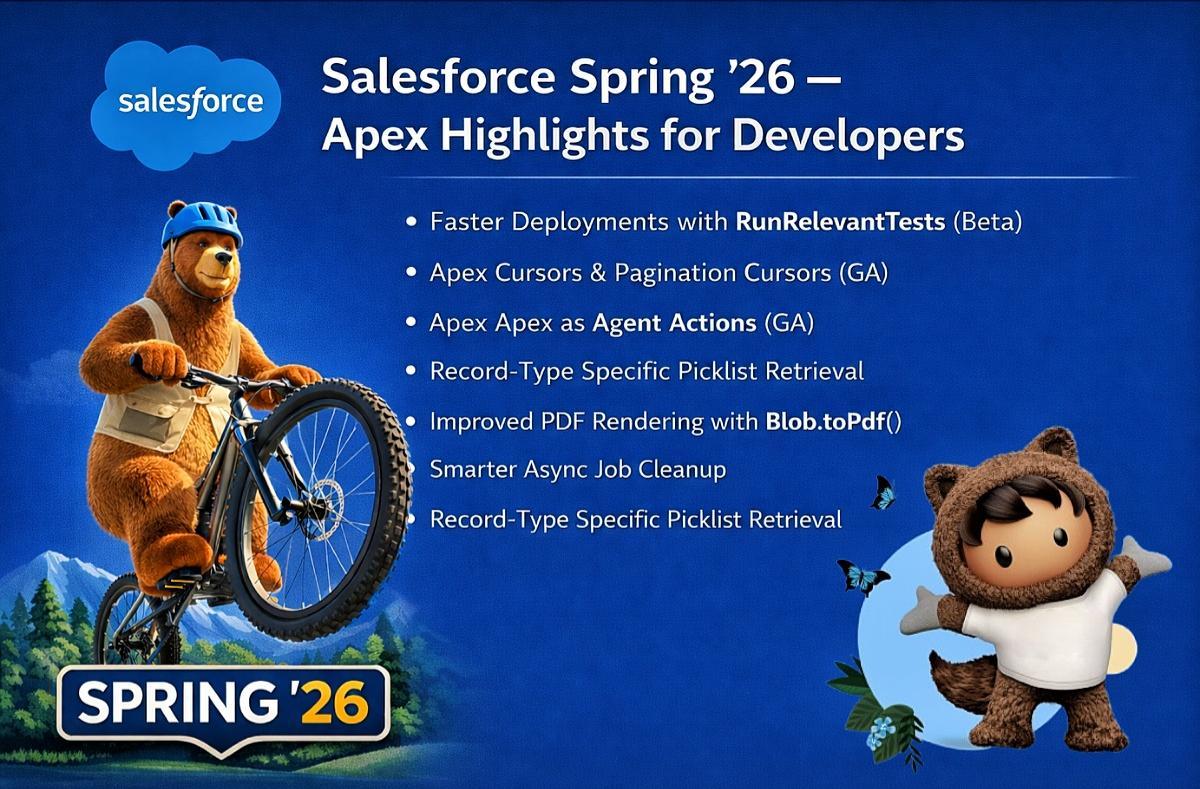
Salesforce Spring ’26: Apex Highlights Every Developer Should Know
The Spring ’26 release from Salesforce continues a clear trend: reducing friction for developers while preparing the platform for AI-first, large-scale enterprise use cases.
Rather than introducing flashy abstractions, this release focuses on improving what Apex developers deal with every day—deployments, data volume, test management, async processing, and tighter integration with Salesforce’s AI ecosystem.
Below are the Apex enhancements in Spring ’26 that matter most in real-world projects.
Faster Deployments with RunRelevantTests (Beta)
Deployments no longer need to execute the entire test suite by default.
With RunRelevantTests, Salesforce intelligently runs only the test classes impacted by the Apex changes in your deployment package.
You can also control execution explicitly:
-
Mark tests that must always run using
@IsTest(critical=true) -
Ensure tests run when specific classes or triggers change using
@IsTest(testFor='ApexClass:ClassName, ApexTrigger:TriggerName')
Why this matters
- Significantly faster deployment cycles
- Fewer CI/CD bottlenecks
- Maintains coverage without unnecessary execution overhead
Apex Cursors & Pagination Cursors (GA)
Apex Cursors introduce a scalable alternative to Batch Apex for handling large data volumes.
Pagination Cursors extend this capability to UI use cases, enabling forward and backward traversal through large result sets.
Why this matters
-
Efficient large-data processing
-
Better user-facing pagination experiences
-
Reduced memory usage and governor limit pressure
Expose Apex as Agent Actions (GA)
Apex REST endpoints and @AuraEnabled methods can now be exposed as Agent Actions and managed via the API Catalog.
This enables direct orchestration with Einstein and Agentforce.
Why this matters
-
Apex becomes a first-class component in AI workflows
-
Cleaner integration between automation, agents, and backend logic
-
Reduced glue code between services
Record-Type Specific Picklist Retrieval
Developers can now retrieve picklist values for a specific record type directly in Apex using:
Why this matters
-
Simplifies dependent picklist logic
-
Eliminates fragile client-side workarounds
-
Improves consistency between UI and server logic
A small change with outsized impact on maintainability.
Improved PDF Rendering with Blob.toPdf()
Blob.toPdf() now leverages the Visualforce rendering engine, resulting in improved:
-
Font consistency
-
Multibyte and international character support
-
Layout fidelity
This makes server-side PDF generation more reliable for enterprise-grade documents.
Smarter Async Job Cleanup
A new overload of System.purgeOldAsyncJobs() enables controlled, incremental cleanup of old async jobs.
Why this matters
-
Safer cleanup in large, long-running orgs
-
Reduced operational risk
-
Better system hygiene without aggressive purging
Filtered Test Discovery API
The Test Discovery API now supports filtering by category (Apex or Flow).
Why this matters
-
Easier management of modular test suites
-
Improved tooling and automation workflows
-
Better visibility into test coverage by technology
Sharing Recalculation Preparation
Salesforce introduced a release update to help identify Apex and Flow logic impacted by upcoming sharing recalculation changes.
Why this matters
-
Enables proactive refactoring
-
Reduces surprise regressions
-
Helps teams stay ahead of platform-level behavior changes
Final Thoughts
Spring ’26 reinforces Salesforce’s direction toward:
-
Faster developer feedback loops
-
AI-first automation
-
Scalable, enterprise-grade architectures
For Apex developers, this release is not about radical change—it’s about removing everyday friction. And that’s exactly what a mature platform should focus on.
At Orbion, we see Spring ’26 as a strong signal that Salesforce is investing in long-term developer productivity, not just surface-level features.
Useful References
-
Salesforce Spring ’26 Release Notes (Official)
https://help.salesforce.com/s/articleView?id=release-notes.salesforce_release_notes.htm -
Apex Release Notes – Spring ’26
https://help.salesforce.com/s/articleView?id=release_notes.rn_apex.htm&release=260&type=5 -
Apex Developer Reference
https://developer.salesforce.com/docs/atlas.en-us.apexref.meta/apexref/apex_releasenotes.htm